Managers are often asked to hold employees to a high standard and also to be someone their team feels safe confiding in. Those two expectations can play a tug-of-war with each other, and it isn’t always clear where a manager’s role ends.
This blog is a guide for when you or your managers need to do both. It covers how to notice when someone may be struggling at work, how to start a supportive conversation, and how to know when to bring in additional help, whether that’s HR or another resource.
Why does workplace mental health matter for managers?
Work is one of the most common places where stress becomes visible. Mental health, like physical health, sits on a continuum. Each person has their own window of tolerance and their own capacity to absorb pressure. This means the same workload can feel manageable to one person and overwhelming to another.
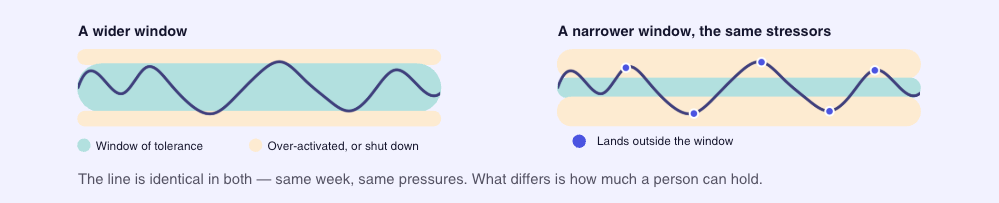
Canadian research points to the value of support at work. According to Mental Health Research Canada (2025), coworker and manager support has one of the strongest positive impacts on employee mental wellbeing. Research also suggests that productivity concerns are less common in workplaces that prioritize burnout prevention (Mental Health Research Canada, 2025).
What are the signs an employee may be struggling?
There isn’t always an obvious sign because more often than not, patterns show up and build over time.
These can include:
- Performance: reduced reliability or a drop in the quality of work
- Engagement: less involvement in day-to-day discussion or connection
- Attendance: more frequent absences or late arrivals
- Demeanour: seeming more tired, less engaged in conversations, or having more frequent emotional reactions
Your role as a manager is to notice and ask questions, not to diagnose. And remember, a single off week doesn’t mean something is wrong, but if you see a sustained pattern, that’s a good reason to check in.
How can managers build trust with their direct reports before it’s needed?
If a team doesn’t feel comfortable with their manager, people are unlikely to share what they’re going through. Trust tends to grow through consistency over time.
So what can managers do to build this trust?
Recurring 1:1 meetings with your direct reports, whether weekly, biweekly, or even a short 15-minute huddle, give people a regular space to bring things up. Having consistent and frequent touch points can help to keep these meetings from becoming only task lists. Leaving room for how someone is feeling and what they’re hoping to achieve makes the conversation feel more human.
{{find-support}}
What should managers say in a check-in?
Open questions tend to work better than yes-or-no questions. “How are you managing with everything on your plate right now?” invites someone to reflect on something specific. “Is everything going well?” is easy to answer with a quick “yes” and leaves little room for detail.
When you're having a meeting or conversation and something has gone off track, leading with curiosity can make a big difference.
Here’s an example:
Rather than opening with “Why didn’t you finish X?”, you might say, “I wanted to check in on how things are going with X. What’s getting in the way?”
This opens the door to the real barrier, whether that’s workload, unclear expectations, or something outside of work.
Your body language matters too. Relaxed posture, natural eye contact, and a calm tone tend to invite more openness than crossed arms or a fixed gaze.
How do you respond when a direct report shares something difficult?
Start by thanking them for trusting you with this information.
What you can say in these conversations:
Phrases like “Thank you for telling me this” or “What would be helpful from me right now?” keep the focus on the person, and not the issue or difficulty they are experiencing.
What to avoid in these conversations:
Try to avoid false reassurance, such as “It’ll be fine” or “Lots of people go through this.” Even when well intended, these can minimize what someone is experiencing.
Not everyone needs the same thing. Some people want to be heard, some need a practical adjustment, and some could benefit from professional support. Part of your job as their manager is to work out which one is most helpful, rather than trying to offer all three.
What support can a manager offer?
Support might look like a regular check-in, time off arranged through HR, an adjusted approach to management, or changes to workload.
Remember: when you agree on support, be clear about what happens next. “I’m waiting to hear back from HR about the accommodations we discussed, and I’ll get back to you by Friday” gives someone something concrete to hold onto. “I’ll follow up when I know more” leaves them guessing.
Supporting someone doesn’t mean removing work expectations. Be clear about what needs to get done and when, stay flexible about how, and involve HR for formal accommodations.
What if the stress is coming from you or your management style?
Sometimes workload, pace, or how a manager runs their team is part of the problem. In those cases, you may only hear about it indirectly.
If you suspect this might be the case, you can try to open that door yourself.
Start by saying something like, “I want to check whether anything about how I’m managing, or the pace we’ve been keeping, is making things harder. I’d genuinely rather know,” signals that feedback is welcome.
Some people won’t feel comfortable raising this with you directly, and that’s okay. Let them know they can also go to HR or a skip-level manager.
When should you escalate to HR?
If an employee shares something beyond what you’re able to support, such as workplace abuse or suicidal thoughts, bring in the right people. Loop in HR and make sure the person has access to crisis resources.
If someone is in crisis, contact local emergency services, or call or text 9-8-8, Canada’s Suicide Crisis Helpline, available 24 hours a day in English and French.
You don’t need all the answers
Managers should not attempt to assess, diagnose, or treat mental health conditions, nor are they expected to. . Instead, the aim is to notice changes, open a conversation, and connect people to appropriate support. Pointing someone to the right resource is often enough.
Some other helpful steps you could take are:
- Connect with other managers
- Asking HR what resources are available
- Ask for help from your senior leader when you need it
Helpful resources for managers
- The National Standard for Psychological Health and Safety in the Workplace for building a workplace mental health strategy
- Workplace Strategies for Mental Health for short articles on a range of topics for employees and managers
- Mental Health First Aid for evidence-based training in responding to mental health concerns
- CAMH’s workplace education and consulting services for leaders
This article is general information for people managers. It is not clinical advice and does not support diagnosis. Guidance on accommodation, leave, and confidentiality varies by province and employer policy, so please confirm these details with HR or legal counsel.
Layla is a Canadian mental health service that connects people with thoughtfully selected therapists, online and in-person, based on their needs, goals, and preferences. Therapy through Layla is currently offered in Ontario, Alberta, British Columbia, and Nova Scotia. Explore Layla →
FAQ
How can a manager tell if an employee is struggling with mental health?
Look for patterns over time rather than one-off changes. Reduced reliability, less engagement in discussions, more frequent absences or late arrivals, and changes in mood or energy are common signs worth checking in on.
What should a manager say to an employee who seems overwhelmed?
Start with an open question, such as “How are you managing with everything on your plate right now?” Then listen, and ask what would be helpful before offering solutions.
Should managers try to diagnose employees?
No. Managers should not attempt to assess, diagnose, or treat mental health conditions, nor are they expected to. Their role is to notice, ask, and connect people to HR, or appropriate professional support.
What should a manager do if an employee mentions suicidal thoughts?
Escalate right away. Loop in HR, and make sure the employee has access to crisis resources, including 9-8-8 (call or text, 24/7, in English and French) or local emergency services if there is immediate danger.