

What is Self-Restraint?
Self-restraint is the ability to act in ways that support what matters most to you, even when emotions, urges, or immediate rewards pull you in another direction. It draws on both self-regulation, which involves planning ahead and creating supportive conditions, and self-control, which involves managing impulses in the moment.
Self-restraint is not fixed
Most of us have moments when we know what we should be doing, yet find ourselves doing something else. Maybe you sit down to study but end up scrolling TikTok instead. Maybe you say something in the moment and later wish you had paused before responding. Or perhaps you’re trying to focus on a task, but your attention keeps drifting elsewhere.
These experiences are part of being human. But they can be frustrating when they pull us away from the things that matter to us, whether that’s doing well in school, being present with family, following through on commitments, or simply feeling more grounded in everyday life.
That’s where self-restraint becomes important. Self-restraint involves both preparing for challenges ahead of time and managing impulses in the moment. It helps bridge the gap between what we intend to do and what we actually do when life becomes stressful, emotional, or distracting.
The encouraging news is that self-restraint is not entirely fixed. While people differ in their natural tendencies, research suggests that our capacity for self-control can be strengthened through practice, supportive habits, and the environments we create for ourselves [1]. Rather than relying on willpower alone, self-restraint often grows through small, repeated choices that make it easier to act in ways that reflect what matters most to us.
────────────
In this blog we’ll cover:
- The difference between self-regulation (guiding yourself over time) and self-control (guiding yourself in the moment)
- Everyday examples of how these skills show up in real life
- Why self-restraint can feel harder at certain times or in certain conditions
- How different parts of our brain drive or undermine self-control
- Four evidence-based techniques - If-then planning, environment design, thought restructuring, and big-picture thinking
- Key takeaways to remember when building your own self-restraint
────────────
Before You Read: We understand that the information and strategies we share may not resonate with everyone. If you're looking for additional support, we encourage you to reach out to a qualified mental health professional. If you're considering therapy, Layla's Care team can help simplify the process through personalized therapist matching and support.
Why Self-Control and Self-Regulation Matter for Self-Restraint
Building self-restraint is less about “perfect willpower” and more about understanding how your brain works and giving yourself the right support. Sometimes that means planning ahead to minimize temptations, and other times it means pausing in the moment to reframe the experience.
Progress happens in small, repeatable steps, and every time you practice, you strengthen the pathways that make future self-restraint easier.
The role of self-control and self-regulation for self-restraint
- Self-restraint can falter at two stages: planning ahead (self-regulation) and resisting in the moment (self-control)
- These skills reflect brain processes: the prefrontal cortex helps plan and regulate, while the amygdala and nucleus accumbens drive emotional and reward impulses
- Certain mental health conditions affect how the brain manages focus and impulse control. That reflects brain wiring, not a personal flaw
- To improve self-regulation: use if-then planning, shape your environment, and support your wellbeing
- To improve self-control: remember willpower is renewable, reframe temptations, and zoom out to the bigger picture
- Slip-ups are normal. The goal isn’t perfection, it’s practice and progress
Self-Regulation vs. Self-Control: What’s the Difference?
- Self-control = resisting impulse in the moment when temptation hits
- Self-regulation = planning ahead to make the right choice easier
Self-regulation refers to the long-term process of learning to manage your emotions and reactions, which is especially helpful in moments where the environment or situation can cause dysregulation. Self-control is the in-the-moment ability to resist a specific impulse or temptation, which becomes a little easier to do when our emotions are regulated. Both of the skills are closely related, but they often involve different strategies and challenges.
Think of your goals like preparing for a road trip.
- Self-regulation is the preparation before you leave: setting the route, packing snacks, charging your phone. It’s the planning that makes the journey smoother. These are the pieces that are within our control, and they help us feel more prepared, grounded, and safe. When our basic needs and supports are already in place, we are less easily pulled into distress. This type of preparation relies on the prefrontal cortex – the part of your brain responsible for planning, organization, and anticipating obstacles. It’s like your brain’s “future thinker” [2].
- Self-control is what happens on the road: resisting the urge to check your phone while driving, ignoring the billboard for roadside attractions, and staying focused on your destination. In these moments, more automatic brain systems are at work:
- Self-restraint is a brain skill, not a personality trait.
- The amygdala, which processes emotions (like stress or frustration) [3].
- The nucleus accumbens, which drives us to chase quick rewards (“Just check your phone, you’ll feel good for a second”) [4].
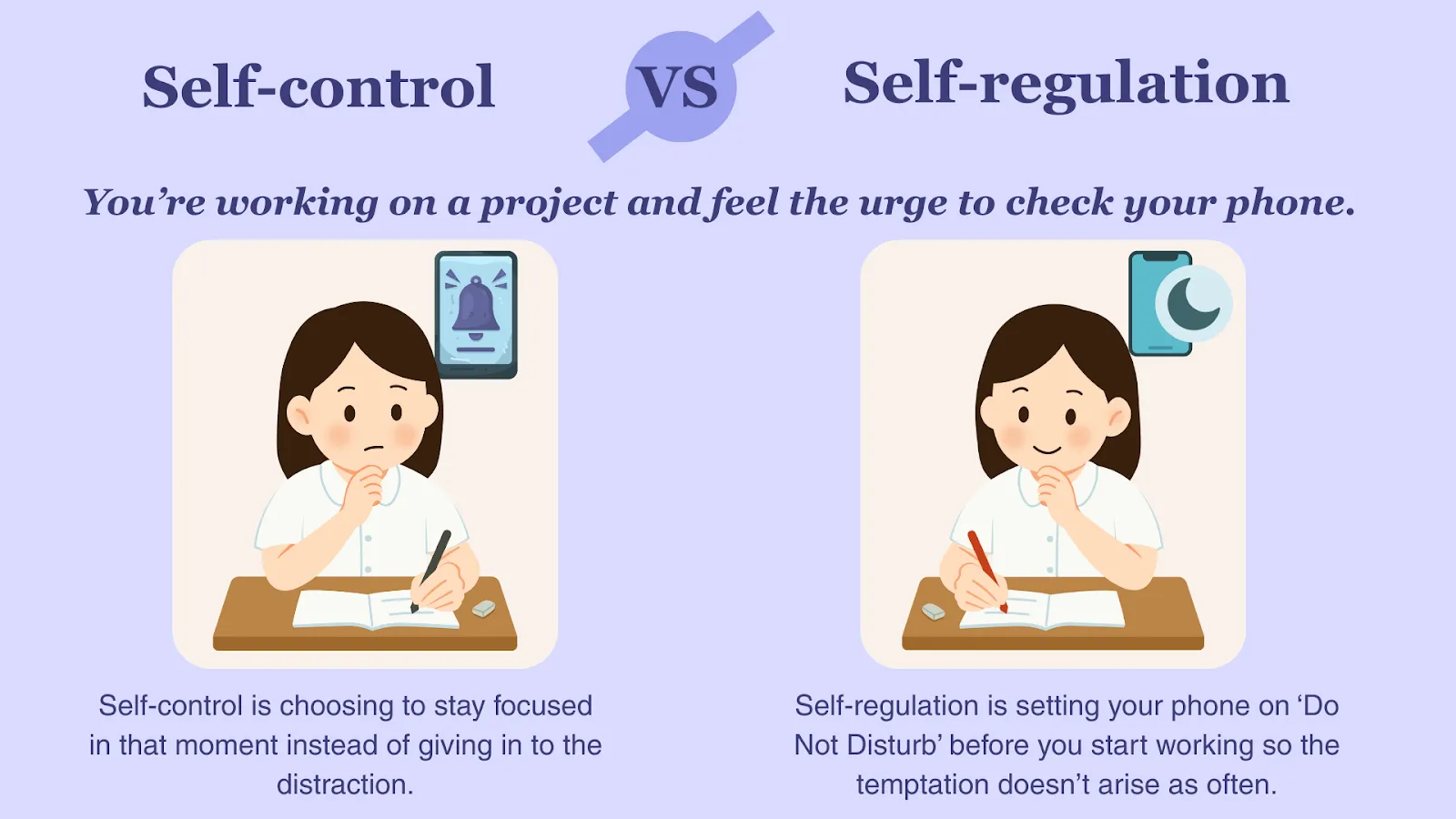
Self-regulation vs. self-control: A quick comparison
Self-restraint is the broader skill that encompasses both self-regulation (long-term planning and goal alignment) and self-control (in-the-moment impulse resistance). Both dimensions improve with practice and intentional strategy.
Why Self-Control Feels Harder for Some (and what’s actually going on in the brain)
For people living with ADHD, bipolar disorder, anxiety, or chronic stress, challenges with impulse control often reflect differences in how the brain's regulatory systems function - not a lack of effort or character. According to the Centre for ADHD Awareness Canada (CADDAC), ADHD affects approximately 1.8 million Canadians, and difficulty with focus and self-regulation is a core feature of the condition.
Everyone experiences distraction and temptation, but for some, these challenges can feel stronger. The brain systems that support planning, focus and impulse control do not work the same way for everyone [5]. When they’re under strain, staying organized, managing impulses, or following through on goals can take extra energy and effort.
It’s important to remember: this isn’t about laziness or lack of willpower. It’s about how different brains and environments interact. Understanding that can help replace self-blame with self-compassion - and open the door to strategies that genuinely support your wellbeing.
Self regulation may be more challenging for:
- Individuals with ADHD (attention and impulse control)
- People who struggle with Anxiety (hypervigilance, avoidance)
- Those who are living with Bipolar disorder (mood-related impulsivity and behavioural changes)
- Someone who is struggling with chronic stress and burnout (difficulty with focus, planning, and self-regulation)
How to Strengthen Self-Regulation: Planning Ahead
Two of the most evidence-based approaches to self-regulation are if-then planning (also called implementation intentions) and environment design (also called choice architecture) - Implementing these skills is an example of your prefrontal cortex at work, creating pathways that make it easier to follow through later.
Environment Design:
Shaping your environment to work better for your goals can help with self-regulation by reducing the intensity that is felt in certain scenarios where self-restraint is required. You can:
- Place your phone in another room when you need focus time
- Keep a water bottle on your desk – hydration supports focus, and having it accessible helps minimize distractions of leaving your workspace [6]
- Put gym clothes out the night before so it’s easier to move in the morning
- Rearrange your kitchen so the healthier snacks are front and center
- Add small cues to your space (like a sticky note with your main priority) that remind you what matters
Implementation Intentions aka if-then planning:
If-then planning, also known as an implementation intention, gives your brain a script [7]. It is a self-regulation strategy that links a specific situation to a planned response. For example: “If I feel tempted to scroll while studying, then I’ll put my phone in another room for 20 minutes.” By making the decision in advance, you reduce the need to rely on willpower in the moment and make it easier to follow through on your intentions.
How to create an effective if-then plan:
- Identify a specific trigger. Choose a situation, feeling, time, or place that commonly leads you away from your goal (e.g., boredom, stress, or receiving a notification)
- Choose a clear response. Decide exactly what action you'll take when the trigger occurs
- Keep it realistic. Your planned response should be achievable in the moment, even when motivation is low
- Write it down. Recording your if-then plan can strengthen commitment and make it easier to remember
- Review and adjust. If a plan isn't working, modify the trigger or response rather than abandoning the strategy altogether
Remember to focus on one behaviour at a time. Starting with a single habit or challenge rather than trying to change everything at once.
Examples of If-Then Planning
- If I feel stressed during a conversation, then I will take three slow breaths before responding
- If I feel tempted to put off a task, then I will work on it for just five minutes
- If I notice myself scrolling social media during work, then I will put my phone in another room until my next break
What to do when you get off track
Getting off track is a normal part of behaviour change. Rather than aiming for perfection, focus on getting started again. Practice failing more productively. Can’t get started on a big project?
- If a task feels overwhelming, begin with a smaller related action, such as sending one email or sketching an outline
- If you’re too restless to focus, try a brief movement break, a quick stretch, or another simple activity that helps channel some of that energy
- If you get distracted, close the distraction deliberately and return to your task. One lapse does not erase your progress.
- If motivation feels low, look for a small step you can take rather than waiting until you feel ready
Progress comes from returning to your goals repeatedly, not from getting it right every time.
How Sleep, Stress, and Emotional Wellbeing Affect Self-Regulation
Stress and uncertainty activate the amygdala, increasing feelings of urgency and making it harder to focus on longer-term goals [8]. Your brain becomes more resilient when your needs for rest, connection, and stability are met. Meeting these needs can help calm the nervous system and support attention, emotional wellbeing and self-regulation over time.
Grounding practices such as journaling, mindful activity, or writing a quick list can help reduce feelings of overwhelm and create space for more deliberate thinking. Building these skills into our day can support emotional regulation and help us respond a little more effectively in moments of stress. When worries arise, try pausing to ask yourself: Is this something I can act on? If yes, take a step towards addressing it. If the answer is no, acknowledge the worry without trying to force it away, and redirect your attention toward the practices or tasks that help you to feel grounded.
Purposely engaging in moments that evoke positive emotions can also strengthen self-regulation. Barbara Fredrickson’s broaden-and-build theory suggests that experiences of joy, calm, or connection can broaden attention and thinking while helping people build psychological resources over time. Small moments of positive experience are not just pleasant; they can support resilience and emotional wellbeing. Taking a walk, playing with a pet, or laughing with a friend can help reduce stress and make it easier to return to your goals with greater focus and perspective.
How to support your self-regulation with wellbeing:
- Prioritize consistent sleep: Sleep plays an important role in attention, decision-making and self-regulation
- Practice brief grounding exercises: Such as journaling, box breathing, or a 5-minute walk
- Reduce decision fatigue by simplifying recurring choices: Such as meals, morning routines
- Seek social connection: Positive social experiences can help reduce stress and make it easier to stay engaged with your goals
How to Strengthen Self-Control in the Moment
When temptation hits and impulse control is tested, the nucleus accumbens lights up, pushing you toward the instant reward. The amygdala adds urgency – “Do it now!” This is where self-control comes in: creating space for the prefrontal cortex to take the wheel.
The encouraging news? Willpower isn’t something that gets used up like a battery. Research shows it’s influenced by belief [9]. If you see self-control as renewable, you’re more likely to persist, even after challenges. Think of times when doing something hard actually energized you: finishing a tough project, waking up without hitting snooze, or sticking to a plan even when it was tempting to quit. Those moments show how the brain can shift from depletion to momentum.
Two strategies can help in the heat of the moment:
- Strategy 1: Cognitive Reappraisal (change the story):
- Nervous before a presentation? Instead of “I’m scared,” try “My body is gearing up to help me perform.” Tempted to check your phone? See it as a chance to practice strengthening your willpower muscle. This reframes how the amygdala interprets the situation, lowering emotional intensity and supports you to stay present [10].
- Strategy 2: Zooming out (big-picture thinking):
- When a task feels boring or frustrating, remind yourself why it matters. Cooking dinner tonight isn’t just another chore, it’s caring for your health. That spreadsheet isn’t just tedious, it supports your team. Seeing the purpose behind the moment activates the prefrontal cortex and helps short-term effort feel worthwhile.
Research consistently shows that connecting daily tasks to meaningful goals strengthens self-regulation and increases persistence over time. The more we connect our actions to purpose, the easier it becomes to steady ourselves in challenging moments. Each time you pause, reframe, or step back, you’re strengthening the brain’s pathways for focus and flexibility. Self-regulation grows from these small moments of awareness, not from perfection, but from practice, patience, and self-kindness.
────────────
Finding the Right Support
If you require any immediate support, please reach out to a professional, or click here to explore our crisis and community resources. If you’d like to inquire about finding mental health support that’s right for you, a member of our team is happy to assist you. You can email us at contact@layla.care for any inquiries, or complete our intake form to reach out to a member of our care team.
────────────
Frequently asked questions
Is willpower a limited resource?
Earlier research suggested willpower depletes like a battery (called "ego depletion"), but more recent studies have produced mixed findings. Some research suggests that beliefs about willpower may influence how people respond to challenges, setbacks, and mental effort. Practically, this means that how you think about your capacity for self-control may affect your persistence when tasks become difficult.
Can self-control be improved?
Yes. Research suggests that self-control can be strengthened over time through practice and supportive strategies such as if-then planning, environmental design, cognitive reappraisal, and regular mindfulness practice may help to strengthen self-regulation and make goal-directed behaviour easier to maintain.
How does ADHD affect self-control?
ADHD affects the brain systems involved in attention, impulse control, reward processing, and executive functioning. People with ADHD are not lacking willpower; their brains process reward and regulation differently. Structured strategies, environmental supports, and professional guidance can make a significant difference.
What is cognitive reappraisal?
Cognitive reappraisal is a term used to describe reshaping your thought process. It is a technique where you deliberately change how you interpret a situation to shift your emotional response. For example, reframing pre-presentation nerves as "my body is preparing me to perform" rather than "I'm scared" can reduce anxiety and improve focus. It's one of the most well-researched emotion regulation strategies in psychology.
What is if-then planning and does it work?
If-then planning (also called implementation intention) involves creating a specific plan in advance: "If [situation], then I will [response]." For example: "If I feel the urge to check my phone while studying, then I'll put it in another room." Research by psychologist Peter Gollwitzer suggests that this approach can increase follow-through on goals by helping people respond more automatically to situations they have planned for in advance.
────────────
References and external links
[1] Baumeister, R. F., Vohs, K. D., & Tice, D. M. (2007). The strength model of self-control. Current Directions in Psychological Science, 16(6), 351–355. https://doi.org/10.1111/j.1467-8721.2007.00534.x
[2] Kane, M. J., Brown, L. H., McVay, J. C., Silvia, P. J., Myin-Germeys, I., & Kwapil, T. R. (2007). For whom the mind wanders, and when: An experience-sampling study of working memory and executive control in daily life. Psychological Science, 18(7), 614–621. https://doi.org/10.1111/j.1467-9280.2007.01948.x
[3] Braver, T. S. (2012). The variable nature of cognitive control: A dual mechanisms framework. Trends in Cognitive Sciences, 16(2), 106–113. https://doi.org/10.1016/j.tics.2011.12.010
[4] Burgess, P. W., Alderman, N., Forbes, C., Costello, A., Coates, L. M., Dawson, D. R., Anderson, N. D., Gilbert, S. J., Dumontheil, I., & Channon, S. (2011). The gateway hypothesis of rostral prefrontal cortex function. Trends in Cognitive Sciences, 15(7), 290–298. https://doi.org/10.1016/j.tics.2011.05.004
[5] Masic, A., & El-Mekkawi, S. F. (2024). Attention deficit hyperactivity disorder in adults: Clinical presentation and management. Egyptian Journal of Neurology, Psychiatry and Neurosurgery, 60, Article 117. https://doi.org/10.1186/s41983-024-00930-9
[6] Benton, D., & Burgess, N. (2009). The effects of hydration status on cognitive performance and mood. British Journal of Nutrition, 101(10), 1535–1543. https://doi.org/10.1017/S0007114508064236
[7] Gazzaley, A., & Rosen, L. D. (2016). The distracted mind: Ancient brains in a high-tech world. MIT Press.
[8] Popkin, B. M., D'Anci, K. E., & Rosenberg, I. H. (2010). Water, hydration, and health. Nutrition Reviews, 68(8), 439–458. https://doi.org/10.1111/j.1753-4887.2010.00304.x
[9] Leroy, S. (2011). Resisting the sirens of temptation while studying: Using reappraisal to increase focus, enthusiasm, and performance. Journal of Applied Social Psychology, 41(7), 1730–1747.
[10] Mrazek, M. D., Franklin, M. S., Phillips, D. T., Baird, B., & Schooler, J. W. (2013). Mindfulness training improves working memory capacity and GRE performance while reducing mind wandering. Psychological Science, 24(5), 776–781. https://doi.org/10.1177/0956797612459659



.webp)
.webp)