

What is procrastination?
Procrastination is the intentional delay of a task, usually something we find boring or difficult, even though we recognize the potential consequences of avoiding it.
Procrastination is often thought of as a time management problem, but research suggests it is more closely connected to emotion regulation. Everyone engages in procrastination to some extent. Struggling with procrastination does not mean someone is lazy or lacking discipline, instead, most times procrastination stems from experiencing difficult emotions, such as anxiety, self-doubt, fear of failure, or overwhelm, and these emotions make a task feel harder to approach. In those moments, putting the task off can provide temporary relief.
Anyone can experience periods of stress, uncertainty, and emotional strain, which can make it more difficult to focus, get started, or follow through on intentions. Research suggests that procrastination is often linked to how we respond to emotional discomfort rather than a lack of willpower. Looking at procrastination through this lens can help shift the conversation away from self-criticism and toward understanding what might be making a task feel difficult to begin with.
Procrastination is a common human experience, but it does not always stem from the same place. For some people, it shows up occasionally during stressful or demanding periods. For others, it becomes a recurring pattern that affects school, work, relationships, and overall well-being.
────────────
In this blog, we’ll cover:
- Why procrastination is not laziness
- How emotions, stress, and overwhelm can make it harder to start
- The brain’s role in motivation, avoidance, and short-term relief
- How anxiety, depression, ADHD, and perfectionism can contribute to procrastination
- Practical ways to break the cycle with more self-compassion
────────────
Part of what makes procrastination so frustrating is that we often understand the consequences of delaying a task, yet still struggle to begin. This disconnect has led researchers to look beyond motivation and time management alone, exploring how the brain processes reward, emotion, attention, and future goals.
Understanding why procrastination happens can help us respond to it with greater insight and effectiveness. In the sections that follow, we'll explore the neuroscience of procrastination, its relationship with anxiety, depression, ADHD, and perfectionism, and practical ways to work with these challenges more compassionately.
Before You Read: We understand that the information and strategies we share may not resonate with everyone. If you're looking for additional support, we encourage you to reach out to a qualified mental health professional. If you're considering therapy, Layla's Care team can help simplify the process through personalized therapist matching and support.
Understanding the brain behind procrastination
Procrastination is not simply a matter of willpower. It is influenced by how the brain responds to effort, stress, reward, and emotional discomfort.
Two important brain systems play a role. One involves regions associated with emotion, motivation, reward, and threat detection. These systems are highly responsive to immediate experiences and can pull us toward activities that feel enjoyable, comforting, or relieving in the short term. The other is the prefrontal cortex, which supports planning, decision-making, self-control, and the ability to keep long-term goals in mind [2]. When these systems work together, it becomes easier to stay focused on what matters, even when a task is challenging. However, stress, fatigue, anxiety, or overwhelm can make immediate relief feel more compelling than future rewards. In those moments, avoiding a task may temporarily reduce discomfort, even if it creates additional stress later.
For example, after a demanding day, you might intend to clean your home but end up watching television instead. The issue is not that you have forgotten your goal or stopped caring about it. Rather, your brain may be responding to the immediate appeal of rest and comfort, making the less demanding option feel easier to choose in the moment.
Dopamine and motivation
Another factor involved in procrastination is dopamine, a neurotransmitter that plays an important role in motivation, learning, and goal-directed behaviour. Rather than simply creating feelings of pleasure, dopamine helps support the mental processes involved in initiating, sustaining, and prioritizing tasks [3].
When dopamine-related processes are functioning less efficiently, it can become more difficult to get started, maintain focus, or persist with challenging tasks. This may help explain why some people find it harder to translate intentions into action, even when they genuinely want to complete a task [3].
The link between procrastination and mental health
While procrastination is often linked to emotional discomfort, emotions are not the only factor involved. Difficulties with attention, executive functioning, motivation, and task initiation can also make it harder to follow through on intentions. As a result, procrastination is commonly associated with conditions such as anxiety, depression, perfectionism, and ADHD, although the underlying reasons may look quite different from person to person.
Perfectionism & procrastination
Perfectionism involves holding yourself to exceptionally high standards while engaging in critical self evaluation when those standards are not met [4, 5]. When mistakes feel like evidence of personal failure rather than a normal part of learning, starting a task can become surprisingly difficult. Procrastination may develop as a way of avoiding the discomfort of not performing as well as hoped.
How anxiety and depression impact procrastination
Anxiety and depression affect decision-making by disrupting the brain’s ability to assess risk, reward, and effort, making procrastination more likely [6].
Those with anxiety tend to overestimate the risk involved, particularly when there is existing fear around a specific association. For example; if someone experiences social anxiety and has to prepare for a presentation, this would provoke a lot of fear, and the risk would feel substantial.
Depression lowers energy and motivation, which increases the effort to complete a task and also reduces the expectation that engaging in a task will feel rewarding [6].
Although both anxiety and depression can contribute to procrastination, they often do so for different reasons. Anxiety tends to make tasks feel threatening or high-stakes, while depression can make them feel exhausting, unimportant, or difficult to engage with.
The impact of ADHD on procrastination
For people with ADHD, procrastination is often linked to challenges with executive functioning, the set of mental skills involved in planning, organizing, prioritizing, and initiating tasks. A task may be important and even urgent, yet still feel difficult to begin.
Motivation can also be more inconsistent. Tasks that are repetitive, routine, or lacking immediate interest may be especially difficult to engage with, even when a person understands their importance. This can create a frustrating gap between intention and action.
Many people with ADHD also find that feelings such as boredom, frustration, overwhelm, or self-doubt can make tasks harder to engage with. When a task feels emotionally uncomfortable or difficult to organize, putting it off may become more likely [7].
The procrastination-emotion cycle works like this:
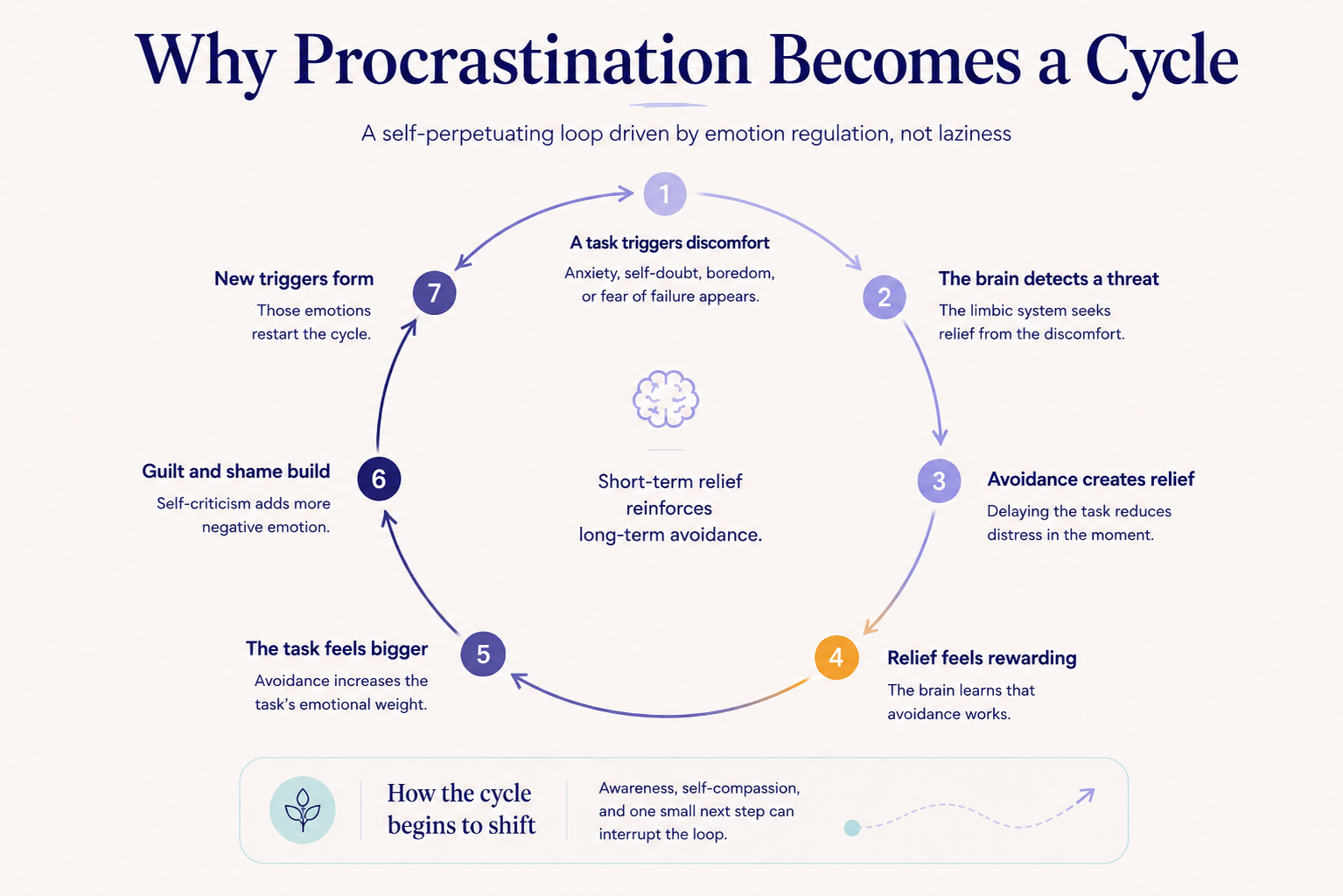
The result: Procrastination is not a failure of willpower. It is a self-reinforcing loop driven by emotion regulation, not laziness.
Supporting yourself through procrastination
Procrastination is often treated as a simple issue of discipline or motivation, but the reality is usually more complex. Whether it is driven by anxiety, perfectionism, ADHD, low mood, overwhelm, or a combination of factors, procrastination often reflects an underlying challenge rather than a lack of effort or care.
Understanding what is getting in the way is often the first step toward making meaningful change. Instead of asking, "Why can't I just do it?" it can be more helpful to ask, "What is making this difficult right now?" That shift in perspective can create space for greater self-awareness, more effective coping strategies, and a more compassionate response to setbacks.
Progress does not usually come from forcing yourself to try harder. It often comes from understanding your patterns, working with your needs, and taking small, manageable steps forward.
────────────
Finding the right support
If you require any immediate support, please reach out to a professional, or click here to explore our crisis and community resources. If you’d like to inquire about finding mental health support that’s right for you, a member of our team is happy to assist you. You can email us at contact@layla.care for any inquiries, or complete our intake form to reach out to a member of our care team.
────────────
References and external links
[1] Centre for Addiction and Mental Health. (n.d.). Mental health statistics. CAMH. https://www.camh.ca/en/driving-change/the-crisis-is-real/mental-health-statistics
[2] TEDx Talks. (2018, February 8). The problem with perfectionism | Thomas Curran | TEDxUniversityofBath [Video]. YouTube. https://www.youtube.com/watch?v=E_PkvNztj1I
[3] Krugers, H. J., & Liston, C. (2021). Stress effects on brain function and cognition. Neuropsychopharmacology, 46(1), 1–2. https://doi.org/10.1038/s41386-021-01132-0
[4] American Psychological Association. (n.d.). Perfectionism. APA Dictionary of Psychology. https://dictionary.apa.org/perfectionism
[5] Smith, M. M., Sherry, S. B., Hewitt, P. L., Saklofske, D. H., & Flett, G. L. (2022). Perfectionism and mental health: A systematic review and meta-analysis. Frontiers in Psychology, 13, 783570. https://doi.org/10.3389/fpsyg.2022.783570
[6] McEwen, B. S., & Akil, H. (2020). Revisiting the stress concept: Implications for affective disorders. Annual Review of Neuroscience, 43, 1–21. https://doi.org/10.1146/annurev-neuro-080317-062007



.webp)
.webp)